

EdUHK Research Team Achieves Breakthroughs at ICML2026
Three Papers Accepted to Advance Stronger, Fairer, and More Trustworthy AI
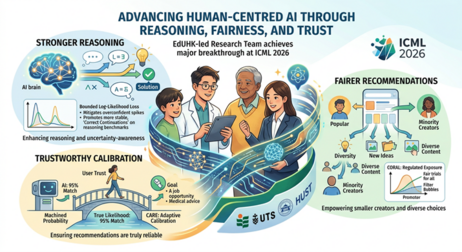
The Education University of Hong Kong (EdUHK), in collaboration with the University of Technology Sydney, Wuhan University, and Huazhong University of Science and Technology, has achieved a major breakthrough at the 43rd International Conference on Machine Learning (ICML) 2026. EdUHK's Chair Professor of the Department of Mathematics and Information Technology Professor Xu Guandong and his research team, including Assistant Professor at Centre for Learning, Teaching and Technology (LTTC) Dr Yu Yang and Research Assistant Mr Nitin Bisht, secured three full paper acceptances and publications, with one selected for an oral spotlight presentation—an honour awarded to only 168 papers out of 23,918 submissions, underscoring the exceptional quality of the team’s research.
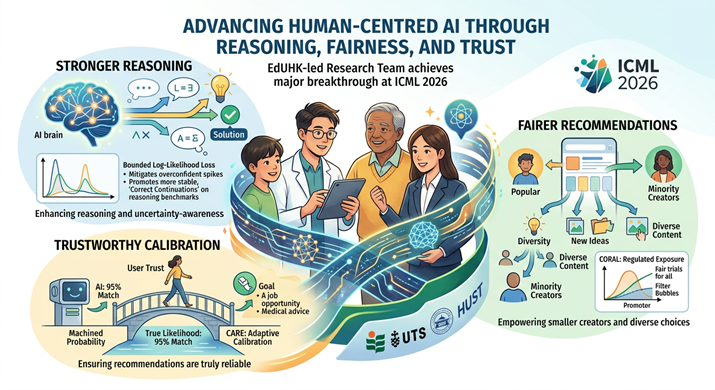
Recognised as one of the world’s most rigorous and influential forums for Artificial Intelligence (AI) research, ICML accepted the three papers that tackle critical challenges in the field. That include strengthening reasoning in large language models, promoting fairness in recommender systems, and improving calibration of confidence scores to enhance trust in AI. These achievements highlight EdUHK’s international academic leadership and the growing importance of human centred AI research.
Strengthening Reasoning in Language Models
The oral spotlight paper, “Don’t Force the Fit: Bounded Log Likelihood Loss for Enhanced Reasoning in Large Language Models”, introduces a novel training objective that mitigates overconfidence and “shortcut” reasoning in LLMs. Professor Xu’s team proposes a deceptively simple yet theoretically profound remedy: a Bounded Log Likelihood (BLL) loss that caps the penalty a model incurs for rare or unpredictable tokens. By preventing runaway loss on unlikely but correct continuations, the BLL loss preserves a healthy amount of uncertainty throughout training.
This method delivers significant improvements across arithmetic, commonsense, and symbolic reasoning benchmarks, advancing uncertainty aware AI systems in high stakes domains such as healthcare, law, and education.
Promoting Fairer Recommendations
The paper “CORAL: Uncertainty Aware Regulation of Exposure Concentration in Recommender Systems” addresses the ethical challenge of exposure concentration, where a handful of popular items dominate user attention. CORAL formalises a dynamic exposure allocation policy that systematically lowers concentration on high certainty popular items while granting regulated exposure to uncertain newcomers — effectively giving promising entrants a fair trial.
The theoretical backbone is a regret bound showing that CORAL’s uncertainty aware regulation achieves near optimal long term fairness without sacrificing recommendation accuracy. The technical innovation lies in a lightweight integration of Bayesian uncertainty estimates into the exposure amplification loop. By reducing filter bubbles, empowering smaller creators, and supporting a more diverse information ecosystem, CORAL advances both fairness and sustainability in recommendation platforms.
Ensuring Trustworthy AI Calibration
The paper “CARE: Adaptive Calibration for Reliable Recommendations” tackles the problem of miscalibrated confidence scores in recommender systems. For example, a job platform might predict a 95% match for a candidate, yet the true likelihood of an interview is only 70%. Such gaps erode trust and can lead to poor decision making in domains such as employment, credit, or health advice.
CARE introduces an adaptive post processing algorithm that learns subgroup specific calibration maps, balancing granularity with statistical reliability. With theoretical guarantees on reducing expected calibration error within each group as data accumulates, CARE becomes more trustworthy over time. Technically, CARE is model agnostic, imposes negligible inference overhead, and can be wrapped around any existing recommender. Its social impact is profound: when recommendation probabilities faithfully reflect true likelihoods, users can make informed choices, platforms become more accountable, and regulatory frameworks gain a robust foundation for evidence based AI outputs.
Collectively, the three ICML papers underscore EdUHK’s leadership in human-centred AI research. As Professor Xu observed: “The most exciting breakthroughs are those that make our models not just more powerful, but more worthy of the trust we place in them.”
In addition, Professor Xu, Dr Yang, and Assistant Professor at LTTC Dr Yin Nan have published four papers at the 32nd ACM SIGKDD International Conference on Knowledge Discovery and Data Mining (KDD) 2026, one of the world’s premier forums for Data Science and AI research. Together, these accomplishments firmly position EdUHK at the forefront of robust, fair, trustworthy, and socially responsible AI research.
— Ends —
EdUHK Research Team Achieves Breakthroughs at ICML 2026 Three Papers Accepted to Advance Stronger, Fairer, and More Trustworthy AI
Download all images