

9th International Forum on Linguistics and Chinese Education (IFOLCE-9)
- 26 Jun, 2026
- Conference
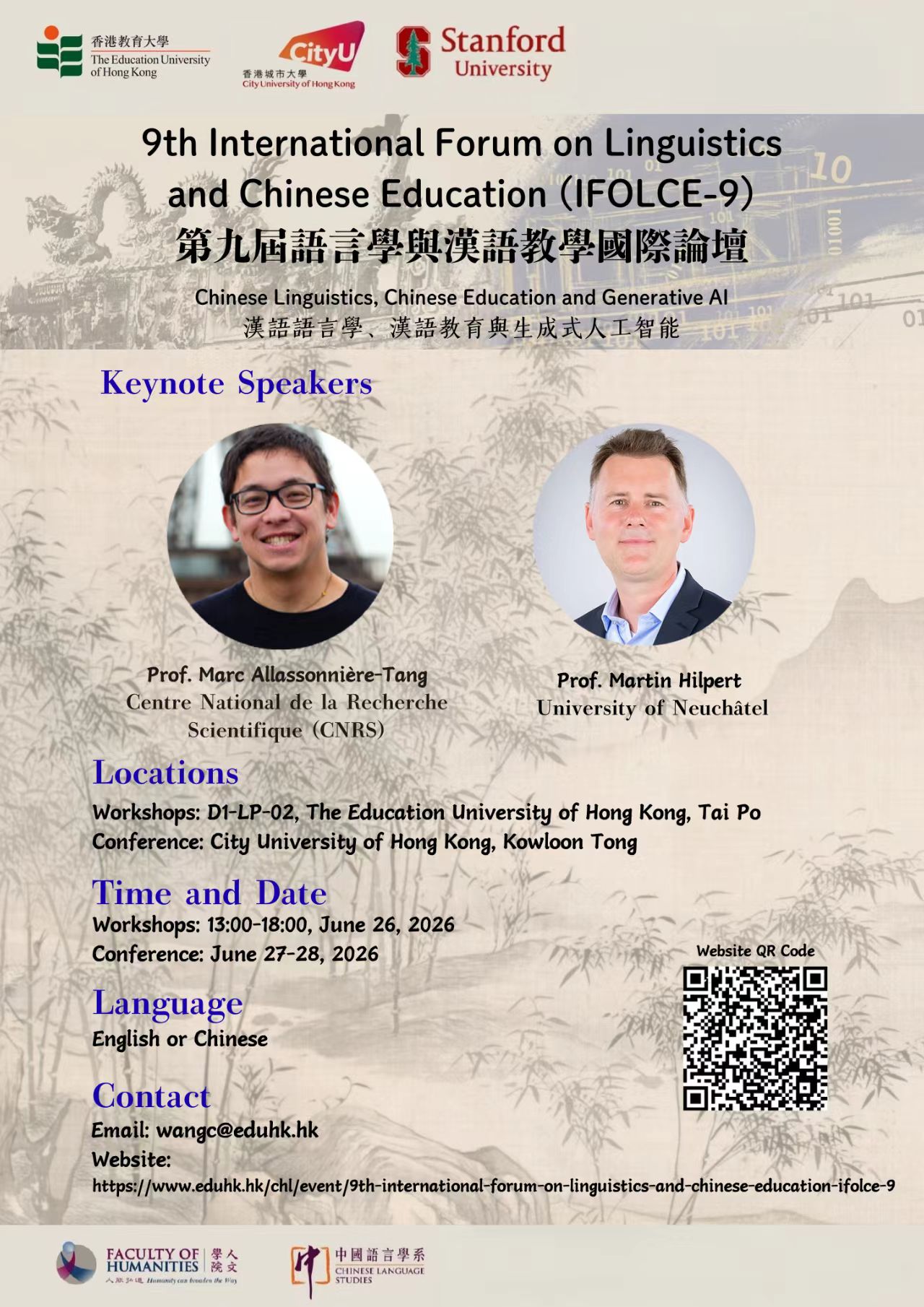
9th International Forum on Linguistics and Chinese Education (IFOLCE-9)
June 26-28, 2026
Third Announcement (Final Call for Papers)
Contact email: wangc@eduhk.hk
Updated forum website: https://lt.cityu.edu.hk/ifolce-9/
Abstract submission deadline extended to: Saturday, January 31, 2026
1. Background and Purposes
The International Forum on Linguistics and Chinese Education (IFOLCE) is an annual academic
gathering committed to advancing the application of contemporary linguistic research in teaching
Chinese as a second language. IFOLCE was first launched in 2015 through a collaborative
initiative among scholars from eight universities across the United States, Chinese Mainland, and
Hong Kong. Since its inception, the forum has been hosted on a rotational basis at three locations
(the US, Chinese Mainland, and Hong Kong) with at least one co-organizer, to foster international
dialogue and scholarly exchange in the relevant fields. IFOLCE-1 was held at University of
California at Davis (co-organizer Columbia University), IFOLCE-2 at Beijing Language and
Culture University (co-organizer Peking University), IFOLCE-3 at University of Notre Dame (coorganizer
Princeton University), IFOLCE-4 at The Chinese University of Hong Kong (coorganizer
Stanford University), IFOLCE-5 at Columbia University (co-organizer UC-Davis),
IFOLCE-6 at Stanford University (co-organizers City University of Hong Kong and the Chinese
Language Teachers Association of California), IFOLCE-7 at Peking University (co-organizer
Beijing Language and Culture University), and IFOLCE-8 at Princeton University (co-organizer
University of Notre Dame). IFOLCE-9 will be hosted by City University of Hong Kong, in
partnership with The Education University of Hong Kong and Stanford University as coorganizers,
from June 26 to 28, 2026. The forum has invited two internationally renowned
scholars as keynote speakers, along with twelve leading scholars in Chinese linguistics and
pedagogy as invited speakers.
The theme of IFOLCE-9 is Chinese Linguistics, Chinese Education, and Generative AI,
advocating cross-disciplinary and empirically oriented research for the advancement of Chineserelated
research and applications in the AI era. The progress in linguistics and Chinese as a second
or foreign language depends on a solid foundation and up-to-date methods in linguistic research
and a meaningful and effective application of new findings and technologies to teaching practices.
The purpose is to elevate the quality and benchmark of Chinese language research and education
worldwide. This mission honors the legacy of pioneering scholars in modern Chinese linguistics
and education, most notably Prof. Yuan Ren Chao and other pioneers, whose contributions
continue to inspire generations of educators and researchers. IFOLCE cordially invites scholars,
educators, and practitioners from around the globe to rigorize and advance the distinguished
tradition of integrating linguistic research into Chinese language education. We welcome
exchanges of the latest findings in cutting-edge research, empirical approaches, and innovative
methods both in theoretical and pedagogical applications, including AI-integrated technologies in
language research and instruction.
2. Conference Plan
(1) Organizers: City University of Hong Kong, The Education University of Hong Kong, Stanford
University
(2) Dates: June 26-28, 2026
(3) Location:
Workshops: The Education University of Hong Kong, Tai Po, HKSAR
Conference: City University of Hong Kong, Kowloon Tong, HKSAR
(4) Schedule:
a) Workshops: June 26, 2026, 1-6 pm
-Workshop 1: Challenges to Chinese linguistics and education in the AI era
-Workshop 2: LLMs and multimodal empirical approaches in linguistic studies
-and a panel discussion
b) Conference: June 27-28
-2 keynote speeches, 12 invited speeches, and session presentations
(5) Keynote Speakers (alphabetic order):
a) Prof. Marc Allassonnière-Tang, Centre National de la Recherche Scientifique (CNRS)
b) Prof. Martin Hilpert, University of Neuchâtel
(6) Invited Speakers (alphabetic order):
a) Prof. Chou, Chih-p’ing, Princeton University
b) Prof. Chu, Chengzhi, University of California, Davis
c) Prof. Cui, Xiliang, Beijing Language and Culture University
d) Prof. Feng, Liping, Beijing Normal University
e) Prof. Jing, Zhuo, University of Oregon
f) Prof. Liu, Jincheng, University of Notre Dame
g) Prof. Liu, Lening, Columbia University
h) Prof. Sun, Chaofen, Stanford University
i) Prof. Wang, Jing, Princeton University
j) Prof. Wang, Zhirong, Columbia University
k) Prof. Zhao, Yang, Peking University
l) Prof. Zhu, Yongping, University of Notre Dame
3. Forum Theme: Chinese Linguistics, Chinese Education, and GenAI
Preferences will be given to papers pertaining to the theme of the forum, but ALL papers are
welcome concerning the following suggested topics (but are not limited to):
a) Innovative linguistic research on various facets of the Chinese language varieties;
b) Application of linguistic research proposals to Chinese as a Second Language (CSL)
theories and practices;
c) Application of new findings in various linguistic subfields (phonetics, phonology, prosodic
structure, morphology, syntax, semantics, and pragmatics) to CSL instruction;
d) Application of cross-disciplinary studies, such as neurolinguistics, psycholinguistics,
corpus linguistics, computational linguistics, sociolinguistics, cognitive linguistics, and
discourse and communication studies, to CSL education;
e) Application of research findings in historical and cultural studies to CSL instruction;
f) Application of research findings in statistical/quantitative linguistics to CSL instruction;
g) Application of research findings in language acquisition and learning to CSL instruction;
h) Application of empirical approaches and advanced technologies, such as LLMs and multimodal
analyses, to CSL education;
i) Research on curriculum design and teaching materials in CSL advanced-level instruction,
including academic Chinese and Chinese for special purposes;
j) Utilizing linguistic research findings for the compilation of dictionaries or textbooks for
CSL instruction;
k) Studies on socially and culturally significant issues in relation to the latest developments
in CSL practices;
l) Studies on any salient issue of Chinese linguistics and applied Chinese linguistics.
4. Submission of Abstracts
(1) Deadline of submission: Saturday, January 31, 2026, by 12 midnight Hong Kong Time
(2) Format and word limit: Word file in Chinese or English; one page without authors’ names
and affiliation.
-Abstracts written in Chinese: between 500 to 600 characters.
-Abstracts written in English: between 300 to 400 words.
(3) Content of Abstract: clearly highlight a research gap and problem, methods to address the
problem, theoretical proposal and key findings, and potential contribution and significance.
(4) Review and notification: All abstracts will be anonymously reviewed, and decisions on
acceptance will be sent out by March 15, 2026. All accepted papers will be delivered on site.
(5) Submission link: Please submit the abstract to EasyChair
(https://easychair.org/conferences?conf=ifolce9).
5. Conference language
English or Chinese
6. Registration
(1) Registration fee
Early bird (on or before 10th April 2026): HK$1200
Regular fee (after 10th April 2026): HK$1400
Full-time student special rate: HK$1200
Special rate for members of CLTAC: HK$1200
(2) Registration form: will be available on the forum website (https://lt.cityu.edu.hk/ifolce-9/).
Please fill out the registration form and pay registration fee by clicking on the payment link on the
form. Both presenters and non-presenters are welcome to participate in the forum and workshop.
(3) Deadline for Registration: May 30, 2026. Requests for registration fee refunds must be
submitted to the IFOLCE-9 organizing committee in writing before April 10, 2026, after which
no refund requests will be accepted.
Note: The registration fee covers lunch on June 27 and 28, dinner on June 27, and tea breaks
throughout the forum.
7. Lodging and Transportation
Lodging Information: 30-50 rooms at CityU Lodge will be reserved for registered conference
participants who indicate preference for campus lodging.
Transportation Information: https://www.cityu.edu.hk/en/about/campus/getting-to-cityu
Campus Map: https://www.cityu.edu.hk/en/about/campus/map
8. Sun Dejin Young Scholar Thesis Award (SYSTA)
This award is first offered as an encouragement to young scholars who wish to devote themselves
to a career in Teaching Chinese as a Second Language, a field in which Dr. Sun Dejin was
especially interested in, and to which he has made numerous important contributions. The award
is an annual prize in the amount of US$200, donated by the founding members of IFOLCE. On
the recommendation of the review committee after reviewing all the SYSTA submissions, a
maximum of three finalists will be invited to present their papers in the special SYSTA session at
the forum. Two nights of local lodging will be provided for these three finalists (one recipient for
each paper) by the organizer free of charge; the finalists must notify the organizer of their travel
plan in a timely manner as required.
(1) Eligibility: The applicant must be 45 years of age (or younger) in the year of the forum.
Applicants are not required to hold a PhD. However, for those who do, the degree must have been
awarded no more than six years prior to the year of the forum.
(2) Applicants must submit an abstract of their thesis before January 31, 2026. Those whose
abstracts are shortlisted as finalists will be asked to submit a full paper by March 15, 2026. The
full paper must be no more than 20 pages (single-spaced) in length and formatted in APA, MLA,
or LSA style or the styles of other core academic journals in Chinese linguistics or language
acquisition. The following should be written as the first line of the paper: “Submission for the
Sun Dejin Young Scholar Thesis Award”. Submitted papers must be original works that have
not been published elsewhere. Priority will be given to applicants who have not received this award
before. A maximum of three finalists will be anonymously reviewed and selected by the review
committee, and the thesis must be presented at the special session of the annual forum.
9. IFOLCE Steering Committee (alphabetical order)
储诚志 Chu, Chengzhi, University of California, Davis 加州大学戴维斯分校
崔希亮 Cui, Xiliang, Beijing Language and Culture University 北京语言大学
刘乐宁 Liu, Lening, Columbia University 哥伦比亚大学
刘美君 Liu, Meichun, City University of Hong Kong 香港城市大学
孙朝奋 Sun, Chaofen, Stanford University 斯坦福大学
王 静 Wang, Jing, Princeton University 普林斯顿大学
王芝蓉 Wang, Zhirong, Columbia University 哥伦比亚大学
赵 杨 Zhao, Yang, Peking University 北京大学
朱永平 Zhu, Yongping, University of Notre Dame 圣母大学
10. IFOLCE-9 Organizing Committee (alphabetic order)
陈伟强 Chan, Timothy Wai Keung, The Education University of Hong Kong 香港教育大学
张紫薇 Cheung, Tszmei, The Education University of Hong Kong 香港教育大学
揭春雨Kit, Chunyu, City University of Hong Kong 香港城市大学
林善敏 Lam, Sin Manw Sophia, The Education University of Hong Kong 香港教育大学
罗燕玲 Law, Yin Ling, The Education University of Hong Kong 香港教育大学
刘美君 Liu, Meichun, City University of Hong Kong 香港城市大学
蔺 荪 Lun, Suen Caesar, City University of Hong Kong 香港城市大学
卿鸿宾Qing, Hongbin, City University of Hong Kong 香港城市大学
孙朝奋 Sun, Chaofen, Stanford University 斯坦福大学
王婵娟 Wang, Chanjuan, The Education University of Hong Kong 香港教育大学
王 聪 Wang, Cong, The Education University of Hong Kong 香港教育大学
Contact Us
Email address: wangc@eduhk.hk