



ABOUT THE UNIVERSITY
The Education University of Hong Kong (EdUHK) is dedicated to teacher education and complementary disciplines. Funded by the University Grants Committee (UGC), the University offers programmes leading to the award of doctoral, master’s and bachelor’s degrees, as well as postgraduate and higher diplomas. As part of its mission, the University also conducts in-service training programmes for teachers. The total number of students to date is around 16,600.
RICH EDUCATION HERITAGE
The University’s history can be traced back to 1881, when the first Government Normal School was established in Wan Chai, albeit for a brief period. As the first full-time, single-purposed teacher training institute in Hong Kong, it can be seen as the historical origin of EdUHK, which has emerged after the evolution and development of local teacher education at different stages. With increasing interest in and demand for teacher education from the government and the public, the Northcote College of Education (1939), Grantham College of Education (1951), Sir Robert Black College of Education (1960), Hong Kong Technical Teachers’ College (1974) and Institute of Language in Education (1982) were founded to provide formal teacher education in Hong Kong.
In April 1994, pursuant to the recommendation of Education Commission Report No. 5, The Hong Kong Institute of Education (HKIEd) was established by amalgamating the four Colleges of Education and the Institute of Language in Education to enhance teacher education and upgrade professional development programmes.
TRANSFORMATION JOURNEY
The Institute came under the aegis of the UGC in July 1996 and moved to the Tai Po campus the following year. In 2004, it was granted self-accrediting status for education programmes following a UGC review. In mid-2007, the Institute promulgated a Development Blueprint for the coming decade, outlining its aspiration to become an education university and to extend its scope of educational and research activities, footprint and academic impact within the Asia-Pacific region. In 2009, the Institute promulgated, for the first time, its “Education-plus” approach under its Strategic Plan 2009–2012 and Beyond, embarking on a transformation journey to an education-focused, multidisciplinary, research-strong university of education.
This was followed by the publication of the Strategic Plan 2013–2016. Entitled Shaping the Future: Excellence in Learning, Teaching and Scholarship, it provided direction, strategies and milestones to guide the Institute’s development, enabling it to further enhance its academic capacity, improve its research infrastructure, and promote its research culture and impact in the areas of education studies, humanities, social sciences, and creative arts and culture.
In September 2015, the UGC submitted its review report to the Education Bureau, recommending that the Institute be awarded the title of university, which the Chief Executive in Council approved in January 2016. Following the passage of the HKIEd (Amendment) Bill at the Legislative Council in mid-May 2016 and upon the publication in the Government Gazette of the HKIEd (Amendment) Ordinance 2016, HKIEd was officially renamed The Education University of Hong Kong (EdUHK) on 27 May 2016. EdUHK was granted full self-accrediting status for all its programmes on 1 April 2018.
The Strategic Plan 2016–2025 guided the University’s development under the Education-plus approach. Representing the collective wisdom of the entire University community, it reflects the University’s strong commitment to making continuous enhancements in learning, teaching, research and knowledge transfer, and its aspiration to have a positive impact on social progress and human development in the local, regional and global contexts.
STRATEGIC PLAN
EdUHK promulgated its Strategic Plan 2025–2031, under the theme of “Education Futures”, to articulate its vision, mission, core values and strategies to nurture students with diverse skills, enabling them to tackle the challenges and seize opportunities in an ever-changing world amidst the digital era. The Strategic Plan focuses on a forward-looking vision of education, emphasising innovation, sustainability and collaboration. It reflects the University’s objective to raise its profile and strengthen impact locally, regionally and globally through high-quality research and scholarship. EdUHK remains committed to nurturing outstanding and caring educators and talented professionals who contribute constructively to sustainable social and economic development in the Hong Kong Special Administrative Region (HKSAR), the nation and beyond.
PROGRAMMES
As the largest teacher education provider in Hong Kong, EdUHK offers teacher education programmes at different levels and in various study modes. Initial teacher education programmes such as the Bachelor of Education (Honours) programmes and Higher Diploma programmes, are offered to prepare students to teach in kindergartens, and primary and secondary schools in Hong Kong. Postgraduate Diplomas in Education programmes are offered for university graduates aspiring to become professional teachers.
In 2025/26, the University offered 54 undergraduate programmes to over 6,300 students and two sub-degree programmes for around 590 students. Building upon its widening academic scope and knowledge base, the University has expanded its programme offerings to cover more subject disciplines and cross-faculty major courses. Starting from the 2025/26 cohort, the University has transformed all 13 existing five-year Bachelor of Education programmes into Double Degree programmes. By integrating non-education degrees with education-related bachelor's degrees, students will deepen their knowledge in existing educational disciplines while also acquiring a more diverse range of knowledge. This enables them to impart a broader spectrum of knowledge to students when they become teachers in the future. EdUHK also launched a variety of new undergraduate programmes covering speech pathology, digital Chinese culture and communication, and personal finance.
At the postgraduate level, the University offers professional doctorate programmes, research postgraduate programmes and a wide array of self-financed taught postgraduate programmes for educators and professionals in education settings, who seek professional advancement. In the 2025/26 academic year, around 420 students were enrolled in four professional doctorate programmes, 190 students were enrolled in six research postgraduate programmes and 58 taught postgraduate programmes were offered for around 6,720 students. In the past year, the University also offered 78 full-time and part-time professional development programmes for around 2,300 students to cater for the development needs of in-service teachers.
GRADUATE ATTRIBUTES
Since 2019/20, the University has implemented a revamped curriculum structure for all undergraduate programmes. Under the revamped common core curriculum, new elements such as credit-bearing experiential learning courses, General Education Interdisciplinary Courses, Breadth Courses and a Capstone Project have been introduced, enabling students to interact academically and professionally across disciplines.
In parallel, since 2019, Professional Excellence, Ethical Responsibility and Innovation (“PEER&I”) has become the framework articulating the attributes of our university graduates. The framework is applicable to sub-degree, undergraduate and postgraduate students with specific descriptions for each level.
BREAKTHROUGHS AND ACHIEVEMENTS
As testimony to its educational leadership, the University ranked 7th worldwide in Education in the QS World University Rankings by Subject 2026, and 3rd globally in Education and Educational Research in the 2026-2027 U.S. News & World Report Best Global Universities Rankings. In the QS World University Rankings 2027, EdUHK ranked 406th, placing it within the top 30% of universities worldwide. As for individual faculty members, 54 EdUHK scholars were named among the world's top 2% most-cited scientists, in the latest annual list released by Stanford University.
EdUHK boasts the largest critical mass of scholars and experts in education and related disciplines in Hong Kong, with academic and teaching staff from 30 countries/regions across five continents and an increasingly internationalised profile of research postgraduate students from different parts of the world. EdUHK had entered into partnerships with over 200 universities and institutions in around 40 countries/regions, together with dual doctoral or master’s degree programmes launched with four partner universities.
The University is dedicated to contributing to teacher and talent development and supporting the strategic plans of nurturing future teachers and talents through diverse initiatives and collaborations, considering societal development in local, national and global aspects. For example, the University has incorporated Greater Bay Area (GBA) elements in its undergraduate curriculum and required students to visit the GBA to equip students with the most up-to-date knowledge of development in the Chinese Mainland. To strengthen students’ understanding of the rule of law and of the importance of National Security, on top of its existing offerings on National and National Security Education, the University has also enriched the undergraduate curriculum by introducing the new curriculum emphasis “Legal Knowledge and National and National Security Education". Outside Hong Kong, the University has contributed to ongoing educational reform in the Belt and Road countries to enhance their higher education capacity, through nationwide projects. Over the years, EdUHK has also partnered with the World Bank, UNESCO, UNEVOC, the Asian Development Bank and the Southeast Asian Ministers of Education Organization to drive educational change.
RESEARCH AND KNOWLEDGE TRANSFER
Leveraging its established niche in education and growing capacity in multidisciplinary fields, the University has advanced boundaries of knowledge through research and knowledge transfer. As of June 2026, with newly funded projects and those previously awarded, senior academics and emerging young scholars at the University were undertaking 237 ongoing projects funded by the Research Grants Council (RGC) and other funding bodies*, with a total amount of HK$212.2 million awarded, in a wide array of disciplines and subjects, including education, social sciences, psychology and linguistics, and humanities and arts, among others.
Research continues to underpin EdUHK’s mission, driving excellence across the University. Over the past year, our research and innovation efforts have achieved strong international standing, reflected in performance across global university rankings and recognition through prestigious innovation awards. These achievements demonstrate sustained progress in advancing research and knowledge transfer. Fifty-four faculty members were listed among the world’s top 2% most-cited scientists by Stanford University in 2025, underscoring the global influence of our scholarly work. Across diverse fields - including neuroscience, healthcare, sustainability, sport, and educational technologies - our research has delivered tangible impact, earning wide recognition within the international academic community.
To maximise the impact of the University’s expanding research strengths, the Knowledge Transfer Sub-office continues to play a vital role in translating research outcomes into societal and commercial benefits through intellectual property development and commercialisation, entrepreneurship talent development, and start-up incubation. In 2025/26, EdUHK researchers collaborated extensively with external partners, delivering 156 translational research and knowledge transfer projects that advanced the application of research outcomes in real-world settings. Efforts were recognised internationally, receiving 45 invention awards, while 18 patent applications were granted. Entrepreneurship development also continued to gain momentum, with over 70 activities organised to nurture entrepreneurial talent and innovation, attracting 4,381 participants. To support emerging ventures, the University provided 36 start-up teams with seed funding, mentorship, training opportunities, and access to investment networks.
* Other funding bodies include the Chief Executive’s Policy Unit, the Environment and Conservation Fund, the Health Bureau, the Hong Kong Jockey Club Equine Welfare Research Foundation, the Innovation and Technology Commission, the Lord Wilson Heritage Trust, the Standing Committee on Language Education and Research, and the Sports Science and Research Funding Scheme (with funding from the HKSAR Government and the Hong Kong Jockey Club Charities Trust (HKJCCT))
CAMPUS
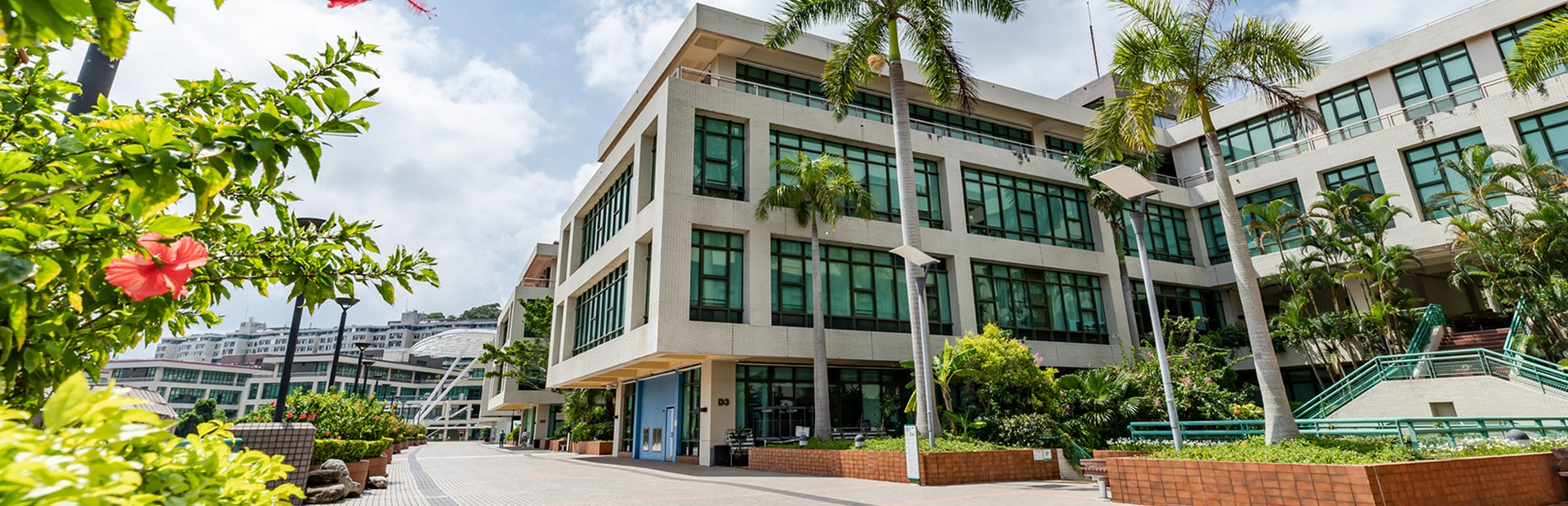
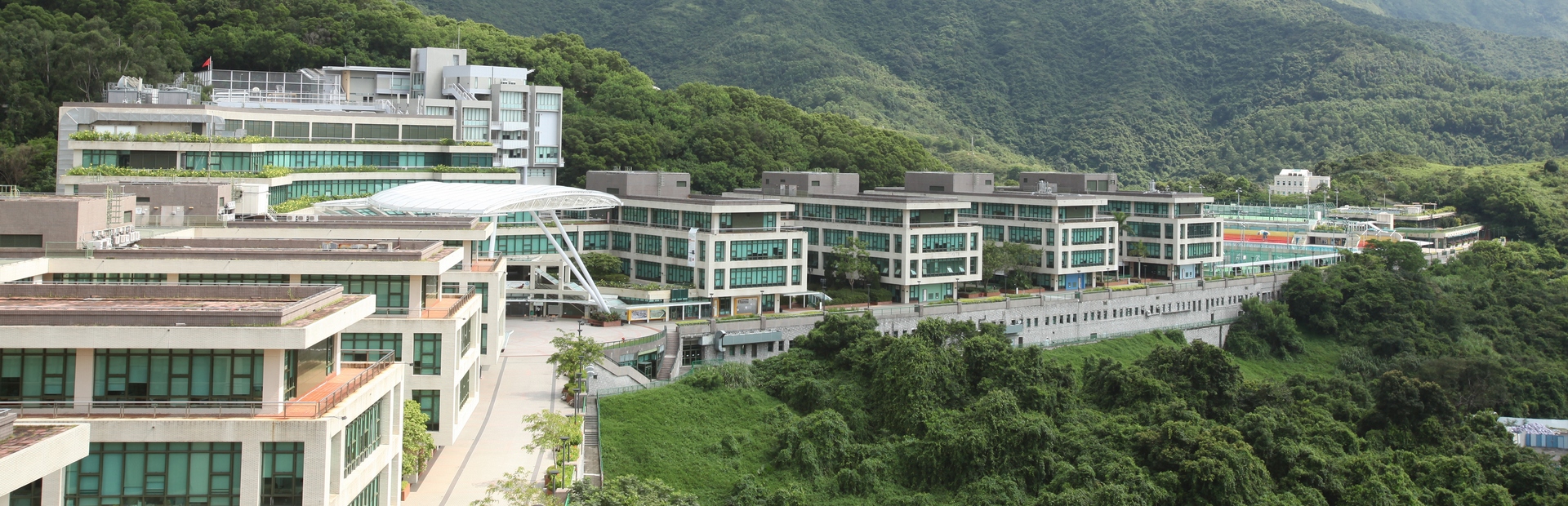
The purpose-built campus, surrounded by the lush greenery of a mountain range, is divided by a central spine road, with student hostels and staff quarters in the upper zone and academic and sports facilities in the lower zone. It also links the main entrance at the south end to the Amenities and Sports Complex at the north end of the campus.
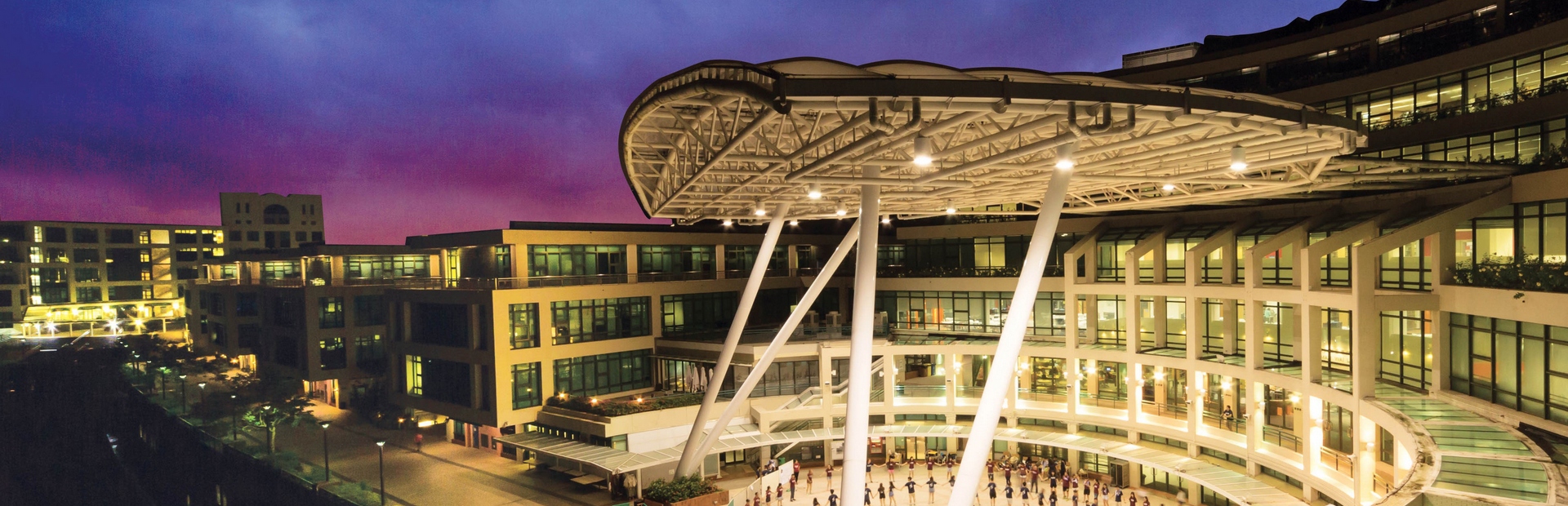
The Main Complex comprises eight blocks of academic buildings, which house the academic staff offices and teaching facilities. The Central Facilities Building, which is located in the centre of the main complex, houses the Library, the IT Help Desk, lecture theatres, the Learning Commons area, a convenience store, student activity rooms and canteens. The covered Central Plaza is the hub of the University, where university-wide events and student activities are held. Designed for 21st century educational trends, eight “Future Classrooms” located in the Library have been operational since 2021, alongside the AI Education Lab and other new research facilities.
The Amenities and Sports Complex at the north end of the campus consists of a Conference Centre, departmental offices and sports facilities, including an Olympic-standard outdoor swimming pool, an indoor training pool, a sports hall, a practice gymnasium, a climbing gymnasium, a table tennis room, two fitness rooms, three squash courts and two sports laboratories. The five-hectare off-campus sports complex at Pak Shek Kok houses outdoor facilities including an athletics track, two full-sized football pitches and three tennis courts for students, staff and their dependents, sports club members and partnership schools.
In addition to the existing Tseung Kwan O Study Centre and North Point Study Centre, two new study centres located at the Xiqu Centre in Austin Road and the M+ Building in Museum Drive in the West Kowloon Cultural District were officially opened in October 2025 and April 2026 respectively to expand the University’s footprint in the prime urban locations.
The first one located at Xiqu Centre, namely the EdUHK West Kowloon Study Centre (Austin Road), features three modern classrooms with seating capacities of 107, 76, and 60 respectively. All classrooms are equipped with state-of-the-art audio-visual equipment to support versatile teaching modes and diverse activities. Additional facilities include learning commons, an open pantry, a discussion room, a sound booth and a floating office. On the other hand, the second one located at M+ Building, namely the EdUHK West Kowloon Study Centre (Museum Drive), features five classrooms with capacities of 47, 47, 70, 86 and 87 students respectively, from which two large classrooms for 117 and 173 students can be formed. The largest classroom is equipped with cutting-edge IT provisions including an extended full-height LED teaching wall to provide an immersive teaching and learning experience; one of the classrooms can also be converted to a multi-purpose area to adapt different class settings and facilitate a wide range of events.
The construction of the New Academic Building on Tai Po Campus was substantially completed in March 2026. With a net operating floor area of approximately 7,600 square metres, this eight-storey building accommodates classrooms, laboratories, a 400-seat multi-functional auditorium, offices, common learning and study place in a modern and effectively utilised structure to support the University’s teaching and research activities through the application of educational technology, pedagogy and interactive learning.
