|
 |
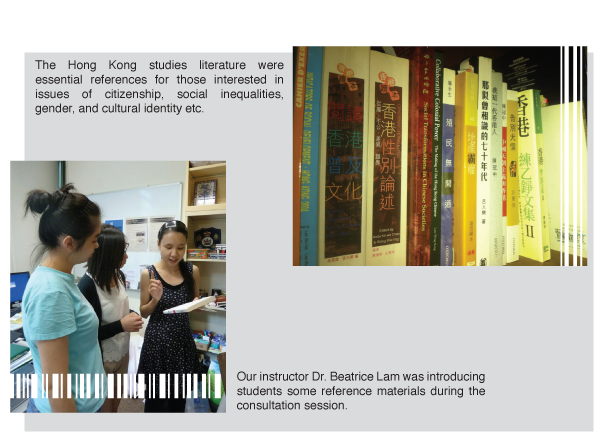
Students had a variety of research ideas, but it was challenging for them to translate their ideas into feasible research questions. They found it most difficult when trying to connect their learned concepts with what they encounter in everyday life.
|
|
 |
 |
 |
 |
 |
 |
 |
 |
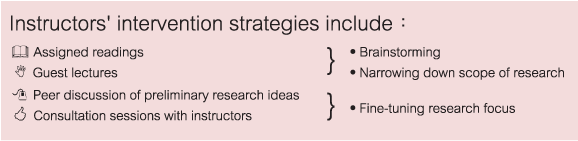
These interventions were especially important for those students who had difficulty in locating literature relevant to their research. |
|
 |
 |
 |
 |
 |
 |
 |
 |

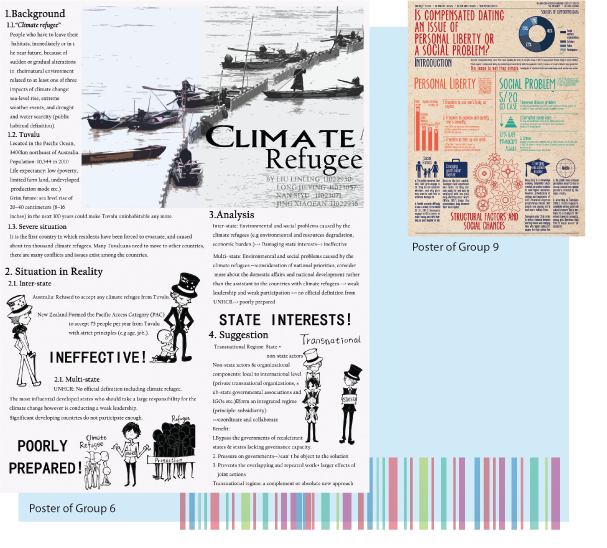
For Group 6, who studied the course 'Global Environmental Governance': 'We were interested in this topic (Climate Refugee)...... We found relevant discussion in the academic papers assigned by the instructor...... With some rethinking and with our instructor's guidance, we were able to do our analysis with reference to the theories in the literature when formulating our study.' |
|
 |
 |
 |
 |
 |
 |
 |
The course 'Self and Society' encourages students to critically explore the subtle impacts of the mass media.
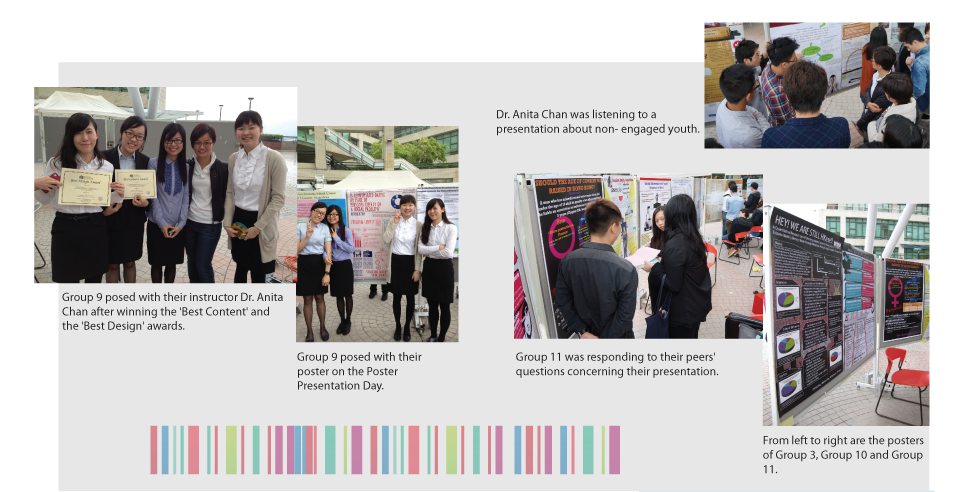
Group 9: 'We decided to have "compensated dating" as our research topic for its controversial nature. We discussed this topic in lectures. We also consulted some academic papers, which point out that the way the media constructs social issues is often shaped by their particular point of view. It is also imperative for us to explore the relationship between social issues and the social structure. In addition, we arranged to meet some youngsters involved in compensated dating for further exchange after hearing them share their experiences in the guest lecture. The more we studied the topic, the more we realized that it is quite different from what we used to think of this issue.'
|
|
 |
 |
 |
 |
 |
 |
 |
'This group demonstrates how we can understand compensated dating as a social phenomenon by thinking beyond a dualistic and moralistic framework. Their study shows how we can make better sense of this social phenomenon from the perspectives of the social structure and social change -- more precisely, the changing youth labour market and the marketization of education in late modernity, the latter responsible for the soaring tuition fees in higher education.' |
|
 |
 |
 |
 |
 |
 |
Group 11: 'At the beginning, our instructor suggested several research areas, which included moral panic, sex education, compensated dating, and parenting. We picked the issue of age of consent, for it seemed to be an issue relevant to all the aforesaid study areas. Studying this topic would allow us to integrate what we have learnt.'
|
|
 |
 |
 |
 |
 |
 |
 |
 |
 |
 |
 |
|
 |
 |
 |
 |
 |
 |
 |
 |
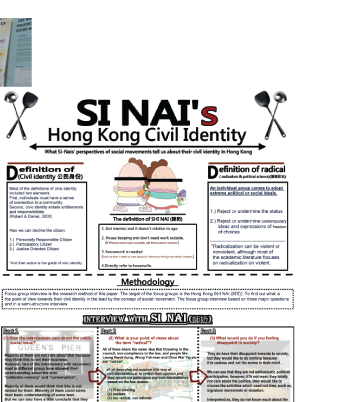
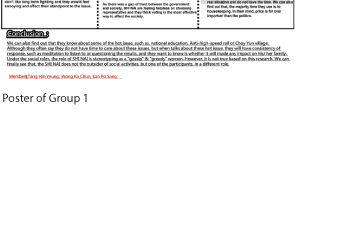
Group 1: 'We were confronted with issues about reliability and validity as we looked for research subjects. We considered whether we should interview a broad spectrum of university students, whether we should target HKIEd students only, etc. In our consultation sessions, the instructor pointed out that we might need to focus on a particular social group based on age or gender as our research subjects. ... we decided to try having "si-nais" as our research subjects, especially how "si- nais" understand Hong Kong identity from the perspective of social movements. Because of the change in research subjects, we must modify our research topic and questions.'
|
|
 |
 |
 |
|
|
|
|
|
|
|
|
|
|
|
|
|
|
|
|
|
|
|
|
|
|
|