Learning and Teaching
Undergraduate Education
After the launch of programmes in complementary disciplines, including the Bachelor of Arts (Honours) in Language Studies and Bachelor of Social Sciences (Honours) in Global and Environmental Studies in 2010-11, among others, the Institute set out to prepare for programme revalidation of these programmes and Programme Area Accreditation (PAA). During the year, the Institute successfully went through these crucial steps, obtaining PAA status for the programme areas of Chinese Studies, English Studies and Environmental Studies, with a view to further diversifying programme offerings. With these positive outcomes, the Institute will embark on the preparatory path of special review to be undertaken by the University Grants Committee (UGC) for application for university title.
New Initiatives and Programmes
A major initiative during the year was the forging of an exchange programme with Beijing Normal University (BNU). Under the collaborative arrangement, 20 students from each institution will participate in an Enriched Student Exchange Programme in which outbound HKIEd students will study at BNU in Semester One of 2014-15, followed by inbound exchange students from BNU in 2015-16. During the course of Enriched Student Exchange Programme at BNU, HKIEd students selected will undertake tailor-made core courses offered by renowned scholars at BNU, and have the precious opportunity to gain local field experience through school visits, class observation and school attachment.
The Bachelor of Education (BEd) Programme Nominations Scheme was introduced for admitting new entrants in 2012-13. Under the Scheme, quality students aspiring to become teachers were nominated by their schools to enrol in our five-year BEd programmes. In view of its success, the Scheme, now renamed Undergraduate Programme Nominations Scheme, will be extended to cover programmes in complementary disciplines. Students admitted under the Scheme may be offered, as appropriate, Entrance Scholarships made possible by generous donations from New Territories General Chamber of Commerce and Po Leung Kuk.
Formal Learning Experience
To groom our students as self-motivated learners, an e-learning policy was implemented in phases during 2012-13 with the introduction of e-portfolios. Through the construction of personal e-portfolios that record co-curricular learning, field experience and overseas exchange activities, students are empowered to monitor and manage their own learning process, through which they can critically reflect on their own learning experiences and become lifelong learners. The student e-portfolios are intended to complement the alignment of teaching, learning and assessment activities and strategies to student learning outcomes under the Outcome-based Learning approaches. They are infused into field experience and the four pillars of common learning experiences, including Overseas Learning Opportunities, Co-curricular Learning, General Education and Language Enhancement.
To create an English-rich learning environment and facilitate student exchange and internationalisation, the International Tutors Scheme will be gradually implemented in 2014-15, giving our students ample opportunities to communicate with native English speaking overseas university graduates who will be recruited as tutors. Other language enhancement initiatives include an Honours Project that will require students of the 2014-15 cohort onwards to undertake their research projects in English, fine-tuning of the English enhancement curriculum, inter-institutional collaboration on developing language tests, interest clubs and workshops, among others.
Learning through Service and beyond Hong Kong
Our students are groomed not only as competent professionals, but also to be socially caring and compassionate to those in need. Since it was launched by the HKSAR government in 2012-13, primary schools under the After-School Learning Support Partnership Scheme have appointed more than 1,100 HKIEd students as tutors, making the Institute the largest contributor to the Scheme among local universities. While they help pupils from economically disadvantaged families with much-needed academic support, our students also gain valuable learning opportunities and firsthand practical experience. Apart from creating a win-win situation for our students and the pupils taught, participating schools express very positive comments about the performance of HKIEd students and how they have been equipped. In view of the outcome, the Institute has enhanced the Scheme by providing extra training on special needs. Upon completion of training and after careful selection, 20 students have been chosen to support special needs pupils who study in eight secondary schools in Tai Po since September 2013.
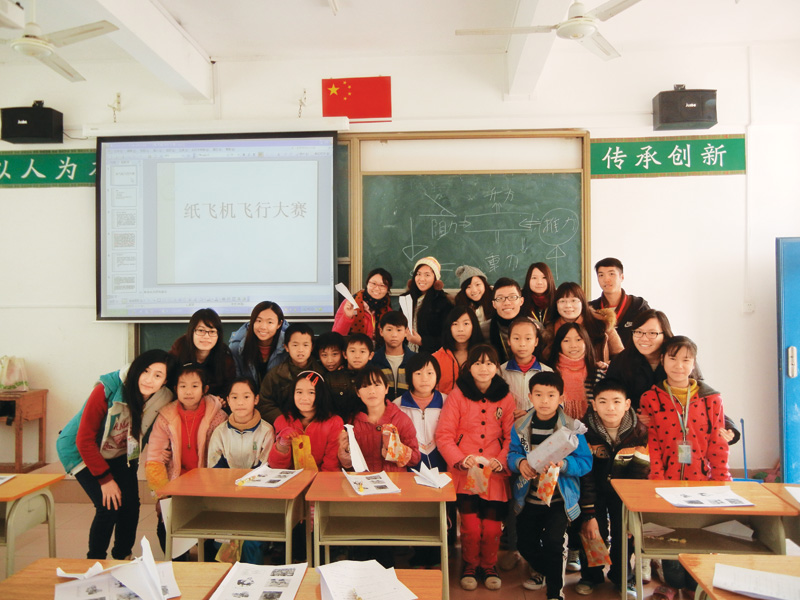
With the introduction of the International and Regional Learning Enhancement Fund (IRLEF) in the last academic year, eligible full-time UGCfunded undergraduates will have the opportunity to participate in community service or internship activities held locally and beyond Hong Kong, with subsidies of up to $10,000 per person. During the year close to 1,500 students, including those supported by the IRLEF, could join exchange, language immersion and community service programmes in the Greater China region, Europe, South and North America, Asia and Australia. Such exposure provides rare learning experiences through which our students can broaden their global outlook and embrace cultural diversity.
Fostering Future Teachers and Learning Community
Education is the cornerstone for enhancing people quality in a society. Ever mindful that the graduates we nurture need to align with the expectations of the education community, the Institute conducted a large-scale Survey of Core Competencies of Future Teachers between January and March 2014. In the feedback of some 1,000 principals, vice principals and middle managers of secondary and primary schools and kindergartens with backgrounds covering government, subsidised, direct subsidy, international, private and special education, the responses informed very unique views of the respondents. Among 15 core competencies given, the five highest ranked items in descending order of importance were positive personality, positive work attitude, cooperation and teamwork, interpersonal skills and professional knowledge and skills. The Institute is taking this feedback very seriously and will carefully review the survey findings and introduce curriculum reform, as necessary, to address the demands of the school sector.
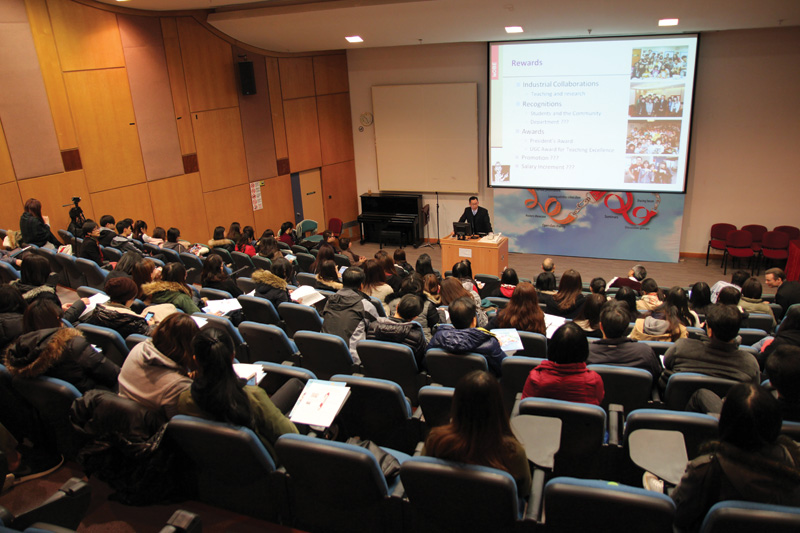
As the cradle of teacher education, the Institute is keenly aware that its teaching and academic staff members should similarly be a learning community. Learning and Teaching @HKIEd 2014 was thus organised from January to April 2014. Under the theme of “Engaging student learning”, a two-day conference, professional development seminars and workshops, open-class teaching sharing sessions, a staff-student sharing forum and a poster display were organised with the participation of staff and students across faculties, the Graduate School and teaching support units.
In the UGC’s funding scheme introduced in August 2013 for Teaching and Learning Related Initiatives in the 2012-15 Triennium, two HKIEd-led proposals secured a total of $11.6 million (with 30 per cent of the funding shared by institutions) to support theme-based projects on teaching and learning. The Institute also participated in five successful projects led by other institutions with a total funding of $42.3 million, in light of the UGC’s encouragement of collaboration among UGC-funded institutions.
Recognition of Teaching Excellence
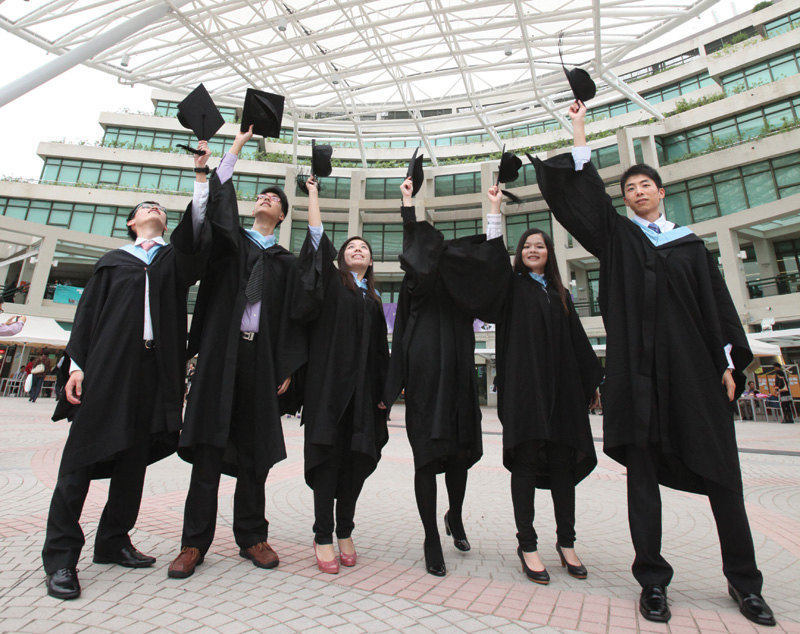
The professionalism and exemplary performance of our graduates were once again fully demonstrated in the Chief Executive’s Awards for Teaching Excellence 2013-14, through which recognition was given in the areas of Curriculum Leadership, Liberal Studies, the Personal, Social and Humanities Education Key Learning Area and the Physical Education Key Learning Area. Of the 67 awardees, 52 were our alumni, with 29 receiving awards and 23 certificates of merit. Since the scheme’s inception in 2003, 542 of 716 awardees (76 per cent) have been graduates of the Institute or its predecessor Colleges of Education. These recipients have been invited as Teaching Consultants to benefit the Institute’s staff and students.
Graduate Education
Since its establishment in 2010, the Graduate School has made significant progress. Compared with the initial 30 places it offered in 2009-10, the Institute has been allocated a total of 45 UGC-funded Research Postgraduate (RPg) places for 2014-15, representing a 50 per cent increase. In addition, the Institute started to recruit RPg students supported by the General Research Fund (GRF) in 2011-12. During the year, around 11 per cent of RPg students were GRF-supported. Coming from Bangladesh, China, Italy, Malaysia, Mexico, the Philippines and Taiwan, these RPg students add further diversity to our campus.
In terms of self-funded taught Master’s programmes, the new Master of Social Sciences in Community Education for Environmental Management and Master of Social Sciences in Psychology (Schools and Community Settings) programmes will be offered in 2014-15. The Master of Social Sciences in Higher Education Policy and Governance, a new programme in collaboration with the Institute of Education, University of London, is planned to be offered in 2015-16.
The International Outreach Programme (IOP) is organised annually by the Graduate School to ensure that our postgraduate students can have academic interactions with their international counterparts. In May 2014 a group of Doctor of Philosophy students, partially funded by the HKSAR Reaching Out Award 2013-14, joined the IOP and visited RMIT University and the University of Wollongong in Australia. Another group of students from the Master of Education programme visited the Teachers College at Columbia University and Rockford University in the United States. Immersed in an international research environment, these postgraduate students had the opportunity to engage in scholarly activities with research students, academic staff and researchers during the visits. To broaden their perspectives and understanding of different cultures, the students also visited local cultural and historical sites.