







Event Highlights: Department of Mathematics and Information Technology at The Education University of Hong Kong Hosts Thematic Workshop "AI, Arts, and Intercultural Skills: Creating the Future of Learning", Featuring Collaboration with Japanese Experts
The Education University of Hong Kong (EdUHK) recently organised a thematic workshop series focusing on AI, Arts, and Intercultural Skills, which took place on 22 and 29 November 2025. This event marked the second joint initiative between Kyushu University (Japan) and EdUHK. The interdisciplinary workshop brought together a teaching team with expertise in cross-cultural informatics, mathematics and IT in education, curriculum and instruction, and cultural and creative arts. By integrating their specialised knowledge in AI, STEM education, artistic creation, and intercultural communication, the team guided participants in exploring innovative pathways for the future of learning.
A unique feature of this workshop was the collaborative learning environment it fostered, allowing 25 students from both universities to engage in hybrid teams that combined both in-person and online participation. This structure provided an authentic, cross-cultural collaborative experience for all involved. The workshop was structured around six core objectives: Systems Thinking & AI Literacy, Critical Thinking & Problem-Solving, Empathy & Collaborative Awareness, Interdisciplinary & International Team Collaboration, Creative Thinking & Innovative Idea Generation, and Global Adaptation & Digital Citizenship. Participants experienced diverse applications of AI in both STEM and arts education, learned to use AI tools for multimodal teaching and assessment, and collaborated in their mixed-mode teams to design and present creative projects.
22 November 2025—Launching Interdisciplinary Exploration in STEM Education
Cross-Cultural Awareness and Project Initiation
On the first day of the event, Dr LI Xiaoyan (Associate Professor, The School of Interdisciplinary Science and Innovation, Kyushu University, Japan) initiated the thematic sharing. During the "Introduction & Project Definition" session, utilising a hybrid online-offline model, she guided participants to complete self-introductions via interactive tools and define project directions in groups, establishing an initial framework for subsequent cross-team collaboration. In the following "Intercultural Communication" session, Dr LI focused on the "explicit and tacit cultural knowledge behind language", analysing core differences in cross-cultural communication through case studies. Engaging in group discussions and task assignments, participants enhanced their awareness of cross-cultural collaboration, effectively dismantling cognitive barriers and fostering progress in transnational and interdisciplinary projects.
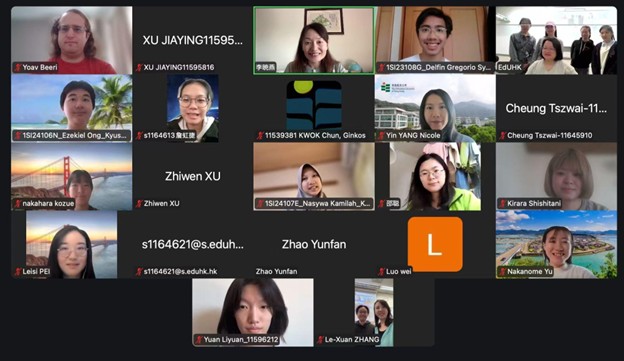
Dr LI guides participants in group formation and project topic discussion during the "Introduction & Project Definition" session
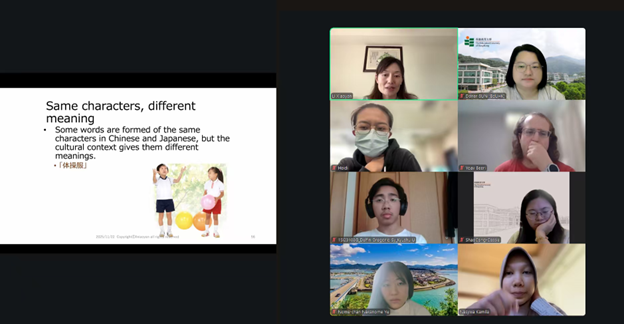
Participants engage in group discussions on "explicit and tacit cultural knowledge" in the "Intercultural Communication" workshop hosted by Dr LI
AI and Metaverse Empowerment
In the afternoon, a team from EdUHK’s Department of Mathematics and Information Technology delivered cutting-edge technology-themed presentations. Dr SUN Daner (Associate Professor, Department of Mathematics and Information Technology, EdUHK) and Dr TING Fridolin Sze Thou (Senior Lecturer I, Department of Mathematics and Information Technology, EdUHK) co-hosted the "AI in STEM Education" session, guiding participants to explore the application scenarios of AI in science, technology, engineering, and mathematics through modular discussions. They outlined key directions for AI-empowered teaching and conducted in-depth discussions around "From STEM to STEAM", proposing the innovative concept of "Fostering Collaborative Superminds with AI" to inspire participants to integrate artistic elements into STEM education and break disciplinary boundaries.
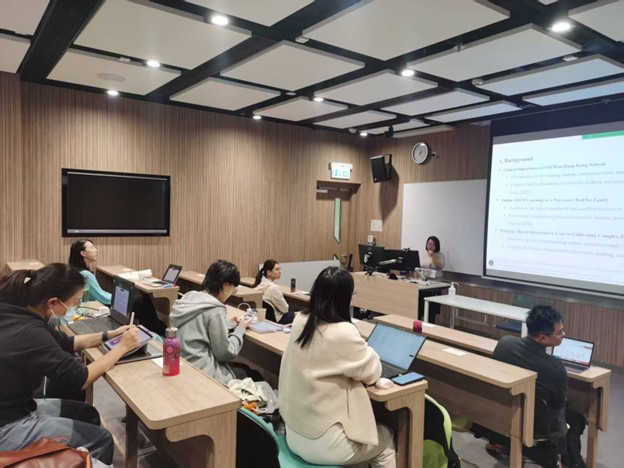
Dr SUN leads brainstorming on exploring AI applications in STEM education with workshop participants
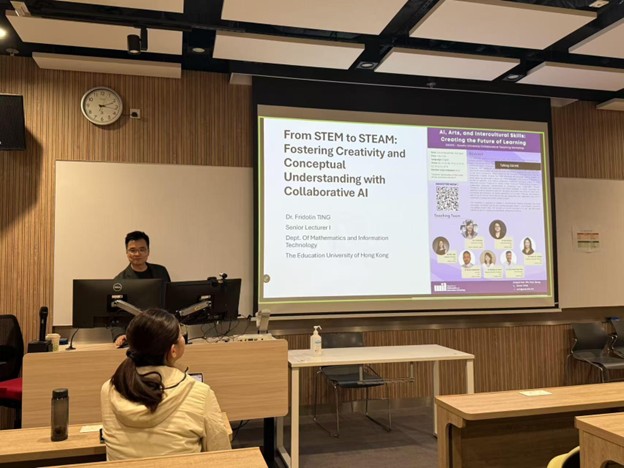
Dr TING shares insights on "From STEM to STEAM: Fostering Collaborative Superminds with AI”
Subsequently, Dr SINGH Manpreet (Lecturer, Department of Mathematics and Information Technology, EdUHK) presented on "Metaverse in STEM Education", introducing the educational value of metaverse technology through examples such as immersive learning and experimental simulation. He also organised group ideation sessions, encouraging participants to design metaverse-based STEM teaching programmes and fostering the innovative integration of technology within educational contexts.
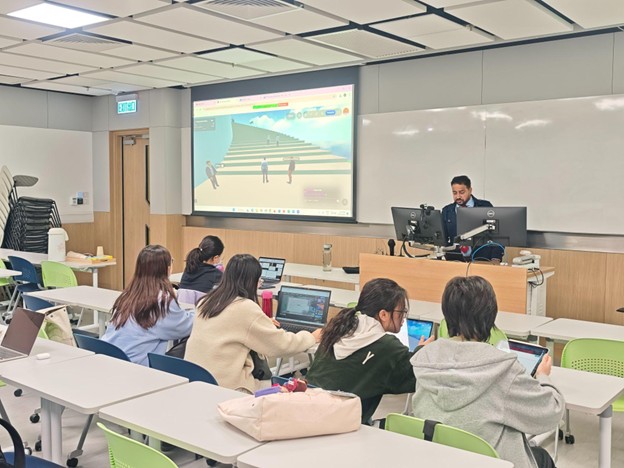
Dr SINGH introduces metaverse application scenarios in STEM education to participants
29 November 2025—Deepening Practical Innovation and Showcasing Interdisciplinary Learning Achievements
Multimodal Learning and Arts Integration
The second phase of the event focused on practical applications. Dr PEI Leisi (Assistant Professor, Department of Curriculum and Instruction, EdUHK) led a session on "AI and Multimodal Learning", focusing on "AI-supported multimodal teaching methods". By integrating the cutting-edge concepts of "Neuroscience and AI for Learning", she guided participants in designing hands-on teaching activities that combined AI technology with a variety of multimodal resources, including text, images, and audio. This approach aimed to enhance interactivity in teaching and improve the efficiency of knowledge transfer.

Dr PEI demonstrates AI-supported multimodal teaching methods during the workshop
Following this, Dr ZHANG Le-Xuan (Research Assistant Professor, Department of Cultural and Creative Arts, EdUHK) facilitated the"Arts Education and Creativity" session, focusing on "Connecting Arts with STEM Inquiry". Through the themed practical activity "Changing the World", participants explored the intersection of art, science, and technology, culminating in the creation of innovative project designs that further developed their interdisciplinary thinking.

Dr ZHANG guides participants in connecting arts with STEM inquiry for creative project design
AI Application in Language Education and Achievement Presentation
In the afternoon, Dr YANG Yin (Research Assistant Professor, Department of Mathematics and Information Technology, EdUHK) delivered a session on "AI in Language Education", focusing specifically on "Formative and Summative Assessment Strategies". Utilising AI-assisted resources, such as the "Language Adaptation Tool", she guided participants in reflective practices, discussing methods to optimise the assessment process in language teaching and enhance instructional accuracy.
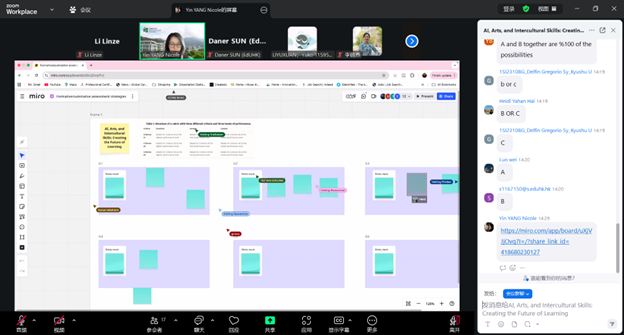
Dr YANG explains formative and summative assessment strategies using AI in language education
During the final "Project Presentations" session, all instructors provided constructive feedback on participants' interdisciplinary projects—including "AI Tool for Cross-Cultural Communication" and "AI Support for Culture Shock". These presentations systematically outlined project backgrounds, core AI technologies, and proposed solutions. Not only did the presentations validate the participants' learning achievements, but they also facilitated the exchange of high-quality programmes, with some projects receiving additional guidance from the faculty team.

One of the participants presents the "AI Tool for Cross-Cultural Communication" project at the final presentation session
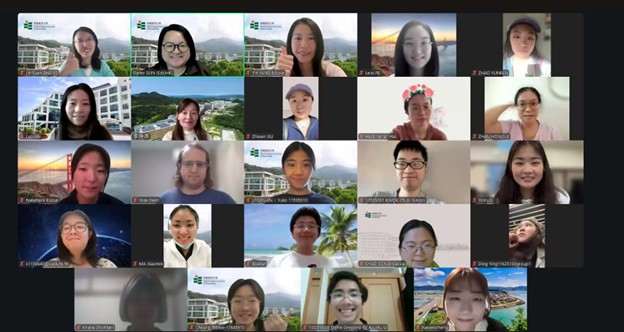
Instructors jointly evaluate participants’ final project presentations during the closing session
Event Summary: Promoting Educational Innovation through Interdisciplinary Collaboration
Leveraging its interdisciplinary resource advantages, EdUHK's thematic event effectively executed a closed-loop design that encompassed "theoretical lecture—practical discussion—achievement output". By integrating cutting-edge technologies such as AI and the metaverse with cross-cultural communication and artistic creativity, this initiative redefined STEM education. Core themes, including "core technology framework", "target user needs", and "project implementation path", were systematically presented through thematic presentations, offering clear learning guidance for participants. This comprehensive approach has significantly enhanced interdisciplinary learning outcomes.
The Department of Mathematics and Information Technology remains committed to integrating interdisciplinary resources and hosting further educational innovation events. By promoting the fusion of advanced technology and teaching practices, we aim to provide a high-quality platform for learning and exchange among educators, students, and industry professionals, thereby contributing to the innovative development of education in Hong Kong and beyond.


