| Date |
2024-03-06 |
| Time |
10:00 - 11:30 |
| E-mail |
urf@eduhk.hk |
| Tel |
29487281 |
|
Enquiry
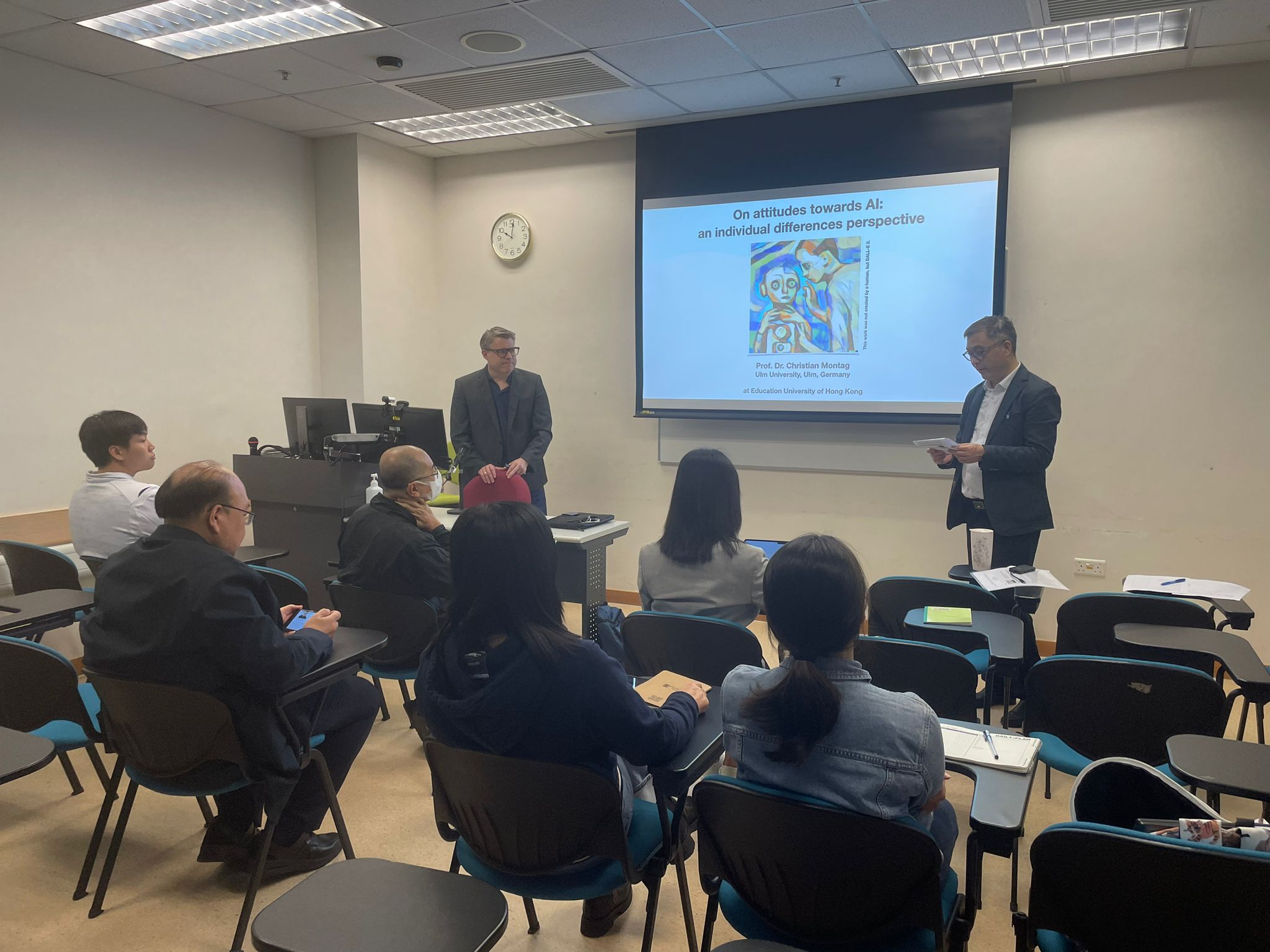
Topic: On attitudes towards artificial intelligence: an individual differences perspective
Artificial intelligence (AI) has been widely discussed in societies worldwide since the launch of ChatGPT in November 2022. Although artificial intelligence is built into many products such as smartphones or social robots, in particular the rise of generative artificial intelligence has led to massive media coverage. This underlines the growing need to understand scientifically how people think about AI. To deal with this topic in a structured way, the IMPACT framework (Interplay of Modality, Person, Area, Country/Culture and Transparency categories) will be presented shedding light on AI-attitude-formation.

Prof. Dr. Christian Montag works at the intersection of psychology, neuroscience, behavioral economics and computer science. He is particularly interested in digital phenotyping, mobile sensing, and digital biomarkers. Moreover, he studies technological use disorders and attempts to understand how social media can be improved. In his most recent works, he focuses on the question on how interaction with AI impacts on the human mind.
Christian Montag received his diploma in psychology in September 2006. In 2009, he achieved his PhD, and in 2011, the venia legendi for psychology. As a post doc he also carried out research at the SCAN lab at Stony Brook University, NY, USA. Since September 2014, he has been a Professor for Molecular Psychology at Ulm University, Ulm, Germany (W3, highest category in Germany). He is a (co-)author of more than 370 peer-reviewed international papers and currently serves on the editorial board of the journals Personality Neuroscience, Molecular Psychology, and Addictive Behaviors. He is a co-editor of the book series “Studies in Neuroscience, Psychology and Behavioral Economics” at Springer. His current H-index is 77 and his works have about 20.000 citations according to Google Scholar.
Montag’s research and insights are often covered by German and international media (such as in the past by The New York Times, CNN, and Forbes).
|
|
|
|