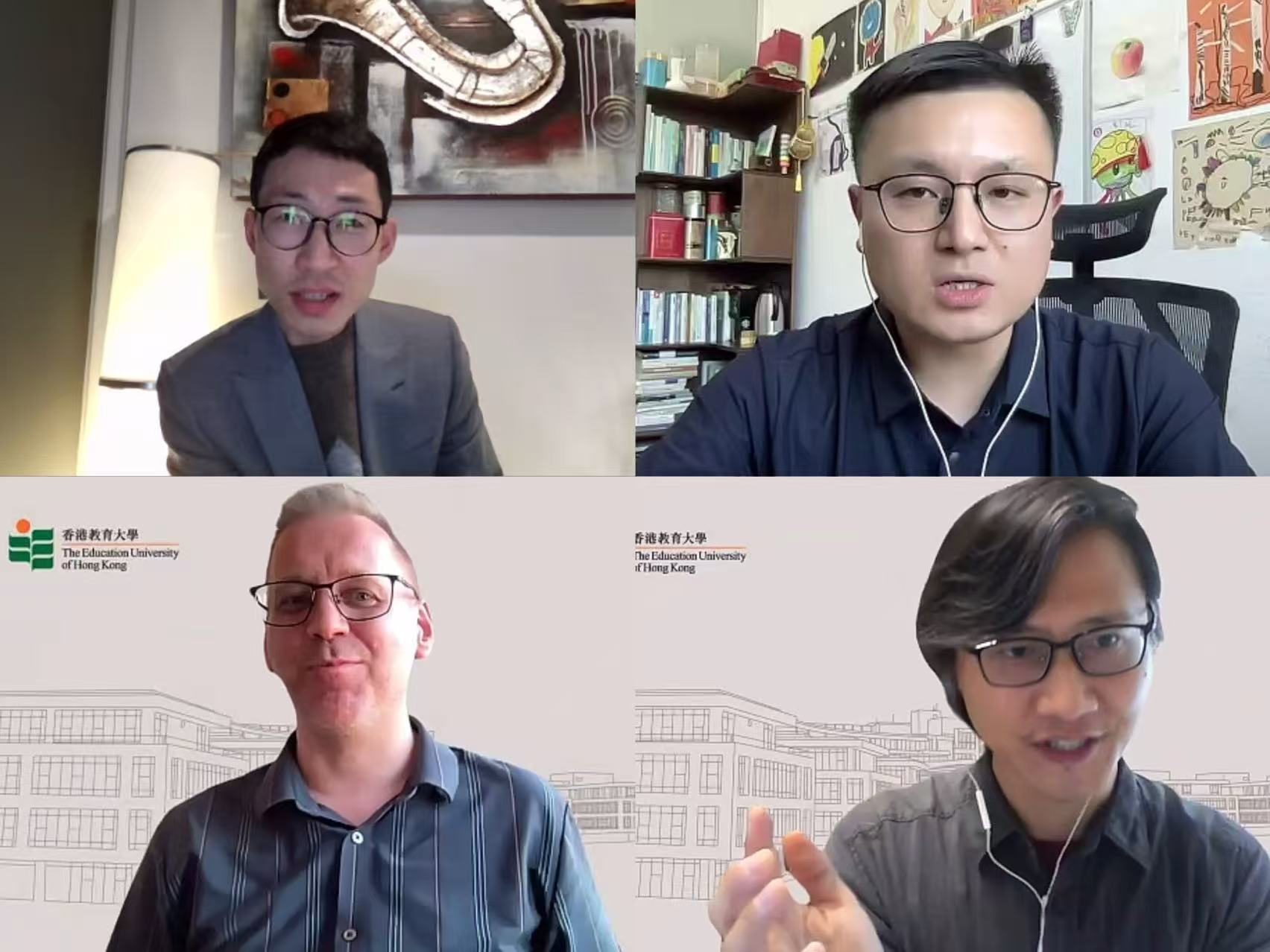
The online forum, "From Personal Insight to Institutional Impact: Using Autoethnography to Inform Educational Policy, Leadership, and Practice," was successfully held on 7 May 2026. It attracted approximately 70 participants from around the world, including academic and teaching staff, PhD students, and prospective master's students from renowned institutions such as the University of Oxford, Beijing Normal University, Tongji University, and the University of Hong Kong.
The forum invited three distinguished scholars to share their perspectives on autoethnographic studies. Dr. Tsang Kwok Kuen, the Programme Leader of the MSc Education Policy and Management programme, served as the chair and delivered the opening presentation. Dr LIAO Wei, from Beijing University, examined how autoethnography can transform unsettling professional experiences—such as cross-cultural teaching or academic boundary-crossing—into opportunities for personal growth, scholarly output, and professional learning, guided by the Chinese philosophy of “reason over emotion” (以理化情). Dr Adam POOLE, from the EdUHK, introduced key autoethnographic approaches, including bricolage and braided methodologies, and illustrated their application through two examples: exploring precarious privilege in international schools (Poole, 2024) and examining funding challenges faced by early-career academics using remixing techniques. His presentation highlighted the value of autoethnography as a critical tool for conducting research both on and by educators in educational studies. Dr Dave YAN, from Monash University, used performance autoethnography and walking as both metaphor and method to examine his transformation as an immigrant and teacher, challenging reductive binary identities. Through cultural psychology of storytelling and diffractive inquiry, he generated affective knowledge and offered a post phenomenological lens on embodiment, reflexive ethics, and the empowering potential of creative scholarship in educational research.