
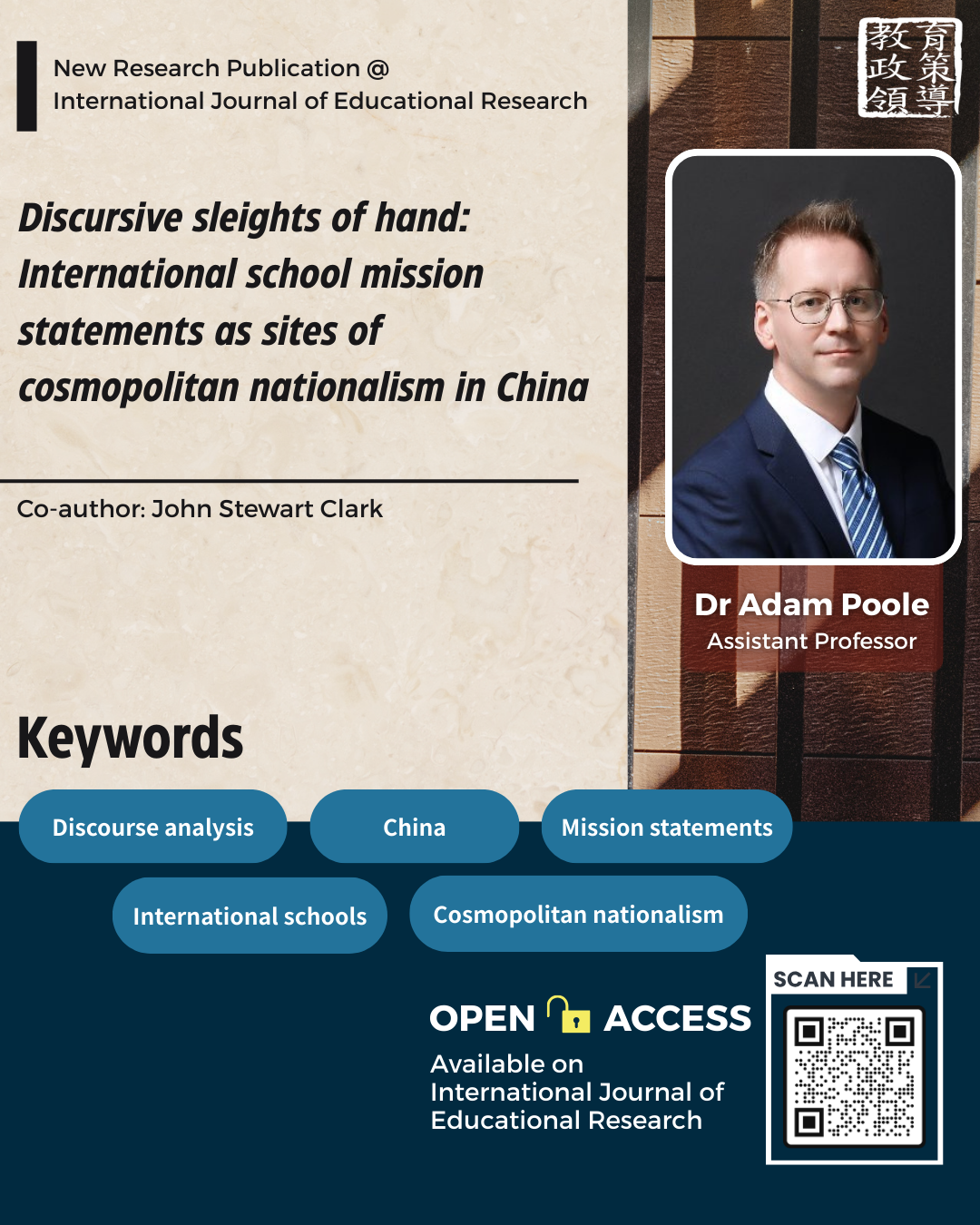
Poole, A., & Clark, J. S. (2026). Discursive sleights of hand: International school mission statements as sites of cosmopolitan nationalism in China. International Journal of Educational Research, 135, 102870. (place external link here) Our study, ‘Discursive sleights of hand: International school mission statements as sites of cosmopolitan nationalism in China’, employed discourse analysis of 34 mission statements from Chinese private internationalised schools offering the IB Primary and Middle Years Programmes to explore how these schools construct hybrid identities under tight state regulation. Using the framework of cosmopolitan nationalism, the paper showed how mission statements rhetorically balance national loyalty and global aspirations through integrative verbs (e.g., “blend,” “integrate”) and culturally resonant metaphors (“roots,” “heart,” “soul”). Whilst these statements simulate hybridity, they subtly privilege a centrally anchored Chinese national identity, reflecting an implicit hierarchy that favours patriotism over cosmopolitan ideals. This meso-level institutional analysis extends scholarship on cosmopolitan nationalism by highlighting how identity negotiations occur discursively within schools, masking tensions between globalizsng education and nationalistic imperatives. The paper calls for further research into how these discursive identities are enacted in practice and how bilingual mission statements perform for different audiences. Why it’s of interest: Academics studying international education, nationalism, and globalisation will value this paper’s meso-level analysis that links policy and school practice, advancing debates on cosmopolitan nationalism and hybridity with a versatile discourse methodology. Policy makers involved in education reform will gain insight into how schools balance regulatory demands and market pressures, highlighting the limits of international education as a tool for global citizenship within national frameworks. Students interested in international education and cultural identity will better understand how schools frame their values, encouraging critical reflection on what “international” means in China and the role of national identity in education.
Click HERE to read the full article.