|
(......Continued)
| |
|
| |
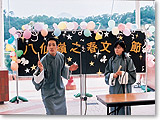
Students' performance at the Spring of Baxianling
- the Literary Festival
|
|
Consolidating
links in the Asia Pacific region
While CRIC was busy forging links that will benefit
us globally, its associate, the Asia Pacific Centre
for Education Leadership and School Quality (APCELSQ)
was reaching out locally as well as in Asia. For example,
it continued its involvement with the Hong Kong School
Leadership Development Network which has principals
and teachers from more than 600 secondary, primary and
special schools and kindergartens in its ranks, by organising
a conference in October 2001 on Leading Schools Achieving
Excellence in Education in the Context of Current Education
Reforms. A few weeks later, APCELSQ was busy coordinating
a two-week training programme for Malaysian primary
school teachers in which the visitors were able to see
how Hong Kong schools tackled the teaching of English
language and Information Technology.
These are details of how one section of the Institute
carried out the strategic objective of forging links
with prestigious institutions worldwide to benefit all
parties and increase the international recognition of
the work we carry out in Hong Kong.
International conferences create global partners
Elsewhere at the Institute many programmes of a similar
nature were underway during the year with the same aim
in mind.
The School of Languages in Education, for instance,
joined with the Chinese University of Hong Kong and
the University of Hong Kong in organising the International
Language in Education Conference which is held annually
in Hong Kong. This year the Institute acted as host
with more than 700 participants from 14 countries -
researchers, curriculum developers, teachers and teacher
educators - taking part.
| |
|
| |
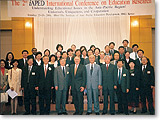
Professor Cheng Yin-cheong (3rd from front
left) represents HKIEd at the 2001 iAPED conference
|
|
The Centre for Citizenship
Education, meanwhile, jointly organised the Second International
Conference on Environmental Education in China: Leadership
for the Future, with the Sun Yat-Sen University in Guangzhou
and the Northeast Normal University, in co-operation
with the University of Minnesota. This was held on the
Sun Yat-Sen campus and explored issues of leadership
in implementing environmental education in a Chinese
context.
The Science Department turned to the important subject
of science curriculum reform in its main symposium,
held in July 2001, with prominent guest speakers from
Australia, Hong Kong and Taipei.
International collaboration at different levels
Collaboration on a more individual basis is another
essential component of our global networking initiatives.
For example, the Department of Creative Arts welcomed
visiting professors from the University of London, Royal
Melbourne Institute of Technology, Australia, the University
of New South Wales in Australia and from Japan as well
as collaborating with the Instituts Universitaires de
Formation des Maitres (IUFM) in France on art immersion
programmes and with the University of British Columbia
in Canada on a music education immersion programme.
Other Schools, Departments and Centres also welcomed
scholars from around the region and the world.
There were exchanges, as well, that allowed both parties
to benefit from the others' best practices and experience.
This was typified by the work of the Chinese Department
in organising a literary festival, the Spring of Baxianling
- the Learning of Literature and Language in collaboration
with the Centre for Language in Education. In this very
successful event, Professor Yan Jiayan of Beijing University
was invited to share his views on Jin Yong novels. Invitations
to other scholars of high academic standing from the
Mainland to visit the Institute for an exchange of views
were also accepted.
|