(......Continued)
| |
|
| |
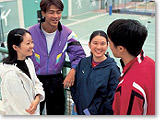
An extensive range of sports and recreational
facilities promote a healthy campus life
|
|
First introduced
in 1998, the BEd(P) has undergone a detailed and comprehensive
review. It was extensively revised to meet community
needs, before being submitted to an international panel
of experts in primary teacher education for external
revalidation. Most encouragingly for us, it received
unanimous support. The one-year Postgraduate Diploma
in Education (Primary) and the one-year Postgraduate
Diploma in Education (Technology) were also successfully
revalidated.
The Bachelor of
Education (Honours) (Early Childhood Education) received
very positive feedback during its revalidation exercise.
Early childhood education is one of the Institute's
strengths and we offer an exciting and innovative programme.
This was reflected in the evaluation given by the international
panel which revalidated the programme and noted the
high degree of satisfaction and enjoyment among students.
The panel also commented that the programme helped students
to become agents of change in the workplace.
Collaborative degree programmes
Our degree programmes are not confined to our own campuses.
In line with the recommendations of the Sutherland Report
on higher education in Hong Kong, we have been working
actively with local universities to develop collaborative
degree programmes. This allows the best of both institutions
to be drawn on to give students subject specialty and
teaching skills.
| |
|
| |
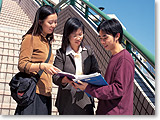
The Institute develops students into teachers
able to instil a love of learning in their
own students
|
|
Our first partner
was the Hong Kong University of Science and Technology.
The first intake of students was in September 2000 for
a full-time, four-year programme, the Bachelor of Science
in Mathematics (Mathematics and IT Education).
As its title implies, this degree produces graduates
who are qualified teachers and who have specialised
in mathematics and information technology. The first
year is spent wholly at the University of Science and
Technology, while from the second year on, students
spend part of their time at the Institute studying education-related
modules. The result is an integrated programme which
prepares teachers to work in secondary schools. The
success of this programme has prompted the Institute
and the University to start developing similar programmes
for science education.
|