|
|
|
|
  |
 |
|
 |
|
|
(......Continued)
Beyond the
specific work of our own teacher education programmes,
the Institute has also made a contribution to the formulation
and implementation of educational policy in Hong Kong.
Many of us have been privileged to serve on bodies such
as the Education Commission, the Advisory Committee on
Teacher Education and Qualifications, the UGC, the Board
of Education, the Curriculum Development Council and its
committees, as well as the subject committees of the Hong
Kong Examinations and Assessment Authority.
Focus on applied research
As a tertiary institution dedicated to teacher education,
research and scholarship which directly supports schools
and teachers in Hong Kong underpins the Institute's role.
A wide range of applied and action research projects are
undertaken by staff of the Institute in collaboration
with teaching practitioners. This ensures that the research
results are directly relevant to the wider teaching community
and to our own curricula. The growth in the quality and
volume of research output reflects the growing academic
strength and scholarship of our staff.
Institutional upgrading
A noteworthy milestone in the Institute's upgrading process
was the successful completion of the UGC's Teaching and
Learning Quality Process Review (TLQPR). This was undertaken
by an international panel, chaired by Professor Rosie
Young, in June 2002. The initial comments of the panel
were very encouraging and attest to the growing maturity
of the Institute since its establishment in 1994. The
TLQPR exercise demonstrated one of the greatest strengths
of the Institute, namely the collegiality and commitment
of its staff to their teaching and to their students'
learning.
The developments outlined above have served to reinforce
our role in providing schools with teachers who are able
to support change and encourage their pupils' learning.
Consequently, the demand to join our programmes has grown
markedly and the employability of our graduates remains
high.
Acknowledgements
In making possible the achievements of the year, I would
like to take this opportunity to thank very warmly our
staff and students for their commitment and professionalism.
I also would like to convey special words of appreciation
to my predecessor, Professor Ruth Hayhoe, for her vision
and leadership. Ruth retired in March 2002, after an eventful
four and half years at the Institute and her invaluable
contributions will long be remembered. My sincere appreciation
also goes to the Chairman of Council, Mr Simon Ip, and
to all the members of Council and its sub-committees for
their steadfast support, advice and encouragement. I would
also like to thank the University Grants Committee and
Government for their strong support to the Institute as
it develops towards a self-accrediting institution.
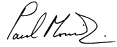
Paul Morris
Director |
|
|
|
 |
| |
|
|
|
|
|
|
|